

This post was published in May 2021, and updated in April 2026.
Patients today expect more from their healthcare experience. They want fast answers and convenient care with fewer hoops to jump through. That includes how they get their prescriptions. Physician dispensing meets that expectation head-on by putting medication directly in patients’ hands before they leave the office.
More clinics are adopting in-office dispensing because it removes a step from the care process. Additionally, it reduces the risk that prescriptions will go unfilled and creates another revenue stream for the practice. For patients, especially those in rural or underserved areas, it can make the difference between starting treatment today or not starting it at all.
This article covers what physician dispensing is, how it works in a clinical setting, the benefits for patients and providers, and the legal landscape you need to navigate. It also discusses how Proficient Rx helps medical practices launch and run successful dispensing programs.
What Is Physician Dispensing?
Physician dispensing is when a licensed provider supplies prescription medications directly to patients during or after their clinical visit, rather than sending them to a retail pharmacy. It’s also commonly referred to as in-office dispensing, point-of-care dispensing, or onsite dispensing.
This is different from an on-site pharmacy staffed by a licensed pharmacist, which requires a full pharmacy operation. With physician dispensing, the prescribing provider or their staff dispenses from a prepackaged inventory maintained within the practice itself.
This model is used across a wide range of practice types, including:
How Physician Dispensing Works
The process is more streamlined than most medical practitioners expect. With the right software and inventory partner in place, dispensing integrates naturally into the existing clinical workflow without adding significant administrative burden.
Workflow in a Clinical Setting
A typical in-office dispensing program follows a clear process:
- Clinical evaluation: The provider assesses the patient and determines a treatment plan.
- Ordering: The provider selects the appropriate medication using e-prescribing or dispensing software, which may integrate with the patient’s electronic health record (EHR).
- Inventory selection: Staff retrieves the medication from the practice’s prepackaged inventory, which is managed through the dispensing program.
- Labeling: The medication is labeled with patient-specific information, dosing instructions, and required compliance data that’s automatically generated by the software.
- Counseling: The provider or staff member reviews the medication with the patient, covering how to take it, what to expect, and any relevant drug interactions.
- Documentation and checkout: The dispensing event is documented, charge capture is completed, and the patient leaves with medication in hand.
Prepackaged, unit-of-use medications are the standard in most programs. They come ready to dispense, reduce the risk of errors, and support traceability. Barcoding and inventory management systems, like those offered by Proficient Rx, make it easy to track stock levels, expiration dates, and usage patterns in real time.
Staff roles are typically divided by state-specific rules. In many states, the physician prescribes, and a trained nurse, medical assistant, or front-desk staff member handles the physical dispensing and checkout under provider supervision.
Medications Commonly Dispensed
Physician dispensing programs are typically built around medications that patients need immediately, including:
- Antibiotics
- Dermatological medications, such as topicals, antifungals, and acne treatments
- Cardiovascular drugs
- Pain and anti-inflammatory medications (NSAIDs, muscle relaxants)
- Respiratory therapies
- Acute and chronic medications where a delay in treatment leads to worse outcomes
Prepacked medications ensure that every medication dispensed is accurate, traceable, and compliant with labeling requirements.
Technology, Data, and Integration
The right dispensing software does more than generate labels. A full-feature platform supports real-time inventory tracking, automated reorder alerts, charge capture, and compliance documentation, all in one place.
Many platforms also integrate with existing EHR systems, reducing duplicate data entry and keeping the patient record complete. Beyond day-to-day operations, dispensing technology provides analytics on medication adherence, utilization trends, and financial performance, giving practices the data they need to refine their program and demonstrate value over time.
Benefits of Physician Dispensing
Physician dispensing creates value for everyone involved. Patients get a more convenient, seamless experience, while providers gain clinical and operational advantages. Additionally, the practice benefits financially while delivering better care.
Benefits for Patients
Convenience is the most immediate benefit. Patients leave the office with their medication already in hand. They don’t have to make an additional stop or wait in line, which reduces the risk of their prescription being unfilled. For patients with mobility limitations or transportation challenges, this matters.
Adherence also improves significantly when the first dose happens the same day as the diagnosis. One of the most persistent problems in outpatient care is primary non-adherence, which is when prescriptions are written but never filled. Dispensing at the point of care nearly eliminates this gap.
Patients also benefit from direct counseling. Instead of receiving instructions from a pharmacist they’ve never met, they hear it from the provider who examined them, in a private setting. For sensitive health conditions, this environment can lead to better understanding and comfort.
Benefits for Providers and Clinics
There are also benefits for providers and clinics:
- Clinical: Dispensing gives providers tighter control over the medication regimen. They can select the exact formulation they want and confirm the patient received it.
- Operational: Clinics see fewer callbacks about prescriptions, fewer authorization headaches, and fewer gaps in the care timeline. Dispensing fits into the workflow rather than creating additional steps outside of it.
- Financial: Physician dispensing adds a meaningful revenue stream that keeps the value of medication services within the practice. When coupled with bulk purchasing through a dispensing partner like Proficient Rx, practices can achieve favorable margins on the medications they’re already recommending.
- Growth: Patients notice convenience. When a visit ends with the prescription already in hand and no extra errands, they remember it and tell others about it.
Legal and Regulatory Considerations
Physician dispensing is legal, but it’s highly regulated. Understanding the framework before launching a program is essential to staying compliant.
Federal and State Oversight
At the federal level, physician dispensing is permitted under Drug Enforcement Administration (DEA) and U.S. Food and Drug Administration (FDA) frameworks, with specific requirements for controlled substances and labeling. However, the rules that govern whether and how a practice can dispense are set primarily at the state level.
Most states allow some form of physician dispensing, but with varying conditions, such as required registration, limits on medications, and rules about patient disclosure. Additionally, a small number of states impose significant restrictions or prohibit dispensing, including New York, Texas, Massachusetts, New Jersey, and Utah.
The regulatory landscape continues to evolve. Clinics considering a dispensing program should review current state statutes carefully and consult with a lawyer familiar with healthcare and pharmacy law before implementation.
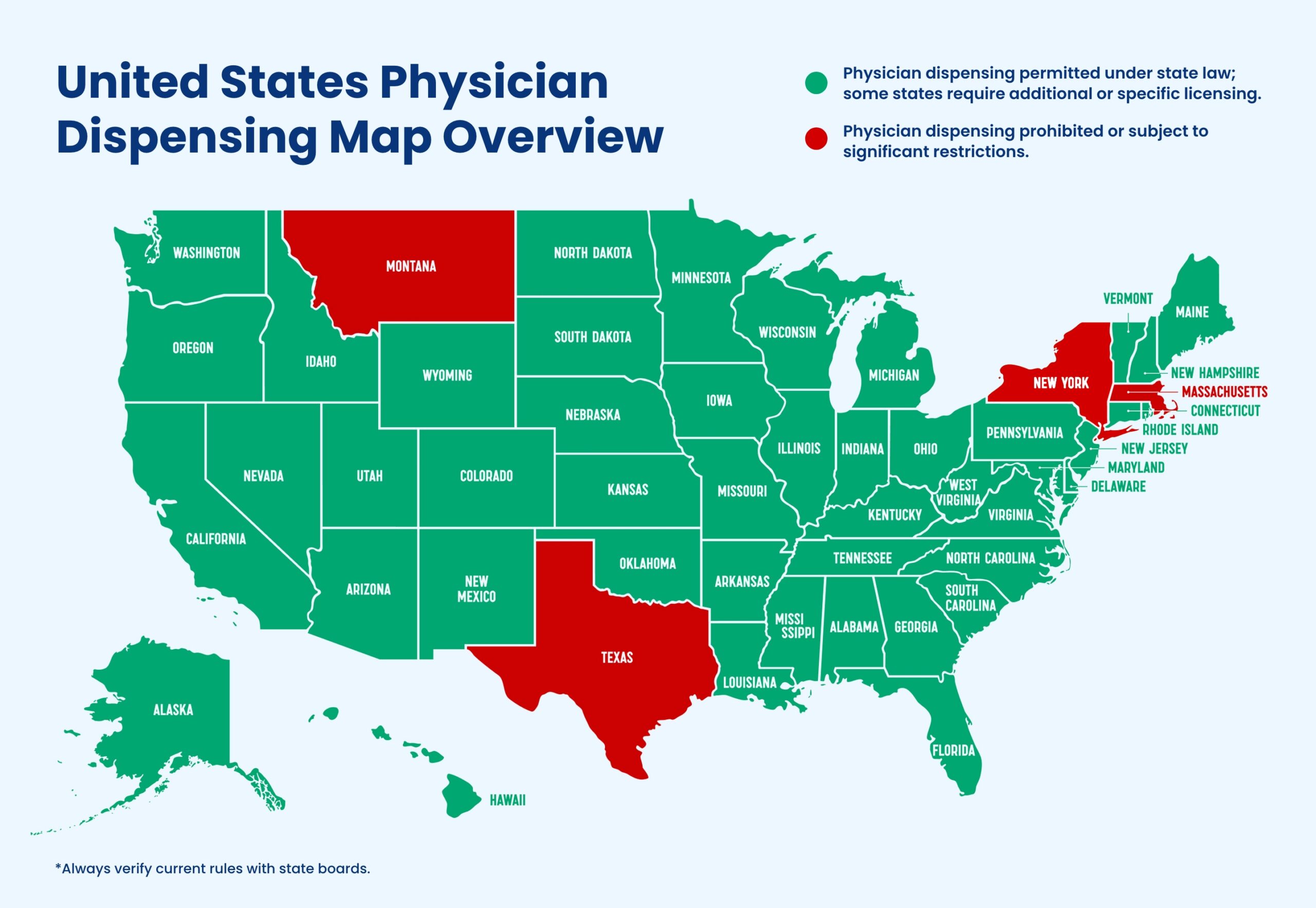
| Region | Permitted States | Restricted/Limited States | Prohibited States |
| Northeast | Connecticut, Delaware, Maine, Maryland, Michigan, Minnesota, New Hampshire, Ohio, Pennsylvania, Rhode Island, Vermont, West Virginia, Wisconsin | District of Columbia, New York | Massachusetts, New Jersey allows dispensing, but they can only dispense a 7-day supply |
| Southeast | Alabama, Arkansas, Florida, Georgia, Kentucky, Louisiana, Mississippi, North Carolina, South Carolina, Tennessee, Virginia | – | – |
| Midwest | Illinois, Indiana, Iowa, Kansas, Missouri, Nebraska, North Dakota, South Dakota | Montana | – |
| Southwest | Arizona, New Mexico, Oklahoma | Utah | Texas |
| West | Alaska, California, Colorado, Hawaii, Idaho, Nevada, Oregon, Washington, Wyoming | – | – |
This information was last updated in April 2026, as laws are subject to change. Please contact us for the most current details.
Licensing, Documentation, and Compliance
Common compliance requirements across states include:
- Dispensing licenses or registration with the state board of pharmacy or medicine
- DEA registration for controlled substances, where applicable
- Adherence to FDA labeling standards
- Recordkeeping systems that track each dispense, patient, and lot number
- Secure storage for medications, including controlled substance safeguarding requirements
- Staff training on dispensing protocols, drug interactions, and documentation
Navigating this complexity is one of the strongest arguments for working with a dedicated dispensing partner. Proficient Rx helps practices stay current with state requirements and maintain documentation standards, so they can operate compliantly from day one.
Impact on Healthcare Delivery and Patient Outcomes
The connection between medication access and patient outcomes is well established. When patients don’t start prescribed treatment, the consequences can be serious. Preventable complications, return visits, and hospitalization all carry real costs to patients and the healthcare system.
On-site dispensing directly addresses the gap between the prescription being written and the patient taking the first dose. Eliminating that gap improves adherence and gives the treatment plan a better chance of working as intended.
For chronic disease management, physician dispensing creates additional touchpoints where providers can monitor whether patients are staying on track and identify barriers to adherence. This allows them to adjust therapy as needed, which aligns with the shift toward value-based care.
Why More Clinics Are Adopting Physician Dispensing
Several factors are driving the growing adoption of physician dispensing:
- Patient expectations: Convenience is a requirement. A doctor’s office that can deliver a complete patient care experience, from evaluation through medication, stands out in a competitive market.
- Revenue diversification: As reimbursement pressures continue, practices are looking for ways to keep more value. Dispensing provides a revenue stream that directly reflects the clinical work they’re already doing.
- Comfort: Integrated point-of-care models are growing. Urgent care centers, employer health clinics, and outpatient practices have seen how dispensing simplifies the patient experience and improves workflow. Word has spread, and more specialty and primary care practices are following suit.
Shift Towards Patient-Centered Care with Proficient Rx
Physician dispensing is a practical, proven model for delivering better care. When patients leave their physician’s office with their medication, treatment starts sooner and patient adherence improves. For providers, it means greater clinical control and fewer administrative headaches.
The benefits are real, but so are the regulatory requirements. Staying compliant means understanding specific rules and maintaining proper documentation while keeping up with a continuously evolving landscape. That’s not something a medical practice should navigate alone.
Proficient Rx makes this easier. We’re a full-service physician dispensing partner that provides prepackaged prescription drugs, dispensing technology, inventory management, and regulatory guidance that make launching and running a dispensing program simple. We offer:
- Responsive customer service from professionals who understand both the clinical and operational sides of dispensing
- Fast, reliable shipping to keep your inventory stocked
- Broad formularies covering the medications most relevant to your specialty
- Knowledgeable support staff who can answer questions about compliance, workflow, and best practices
We walk you through every phase of the dispensing process, from getting licensed and set up to guidance on state-specific requirements. During the onboarding process, we’ll help train your staff, integrate your workflows, and offer continued support to keep your program compliant with regulatory changes and state regulations.
Ready to explore what physician dispensing could look like for your practice? Contact us today to speak with a specialist or schedule a consultation, and take the first step toward a smarter, more patient-centered care model.
The content on this page is intended for informational purposes only and should not be considered medical advice or a substitute for clinical judgment. It is not designed to replace independent evaluation, diagnosis, or treatment decisions made by licensed healthcare professionals. Physicians and other providers should rely on their own expertise and the specific needs of their patients when making clinical decisions.
Frequently Asked Questions
What is physician dispensing?
Physician dispensing is when a licensed healthcare provider supplies prescription medications directly to patients during or after a clinical visit.
What types of medications are commonly dispensed by physicians?
Common categories include antibiotics, dermatology medications, cardiovascular drugs, pain and anti-inflammatory medications, and respiratory therapies.
Is physician dispensing regulated?
Yes. Physician dispensing is regulated at both the federal and state levels. While it’s legal federally, it’s up to each state to set requirements and restrictions.